Nuvoic TechAbility Ian Karten Charitable Trust
Skip to Content
login
karten Network Logo

Supporting organisations working with disabled people

  • Home
  • About Us
    • Introduction
    • Trustees
    • Support Team
    • Minutes of Board Meetings
    • Karten Centre DVD
  • Research
  • Centres
    • Karten Centre Search
    • All Centres
    • Eire
    • England
      • East Midlands
      • East of England
      • London
      • North East
      • North West
      • South East
      • South West
      • West Midlands
      • Yorkshire and The Humber
    • Israel
    • Northern Ireland
    • Scotland
    • Wales
    • Success Stories
    • Equipment Donation
    • Apply for support
  • News
    • Newsletters
  • Resources
    • Mobile Technology Resource
    • eSafety
    • Useful links
    • Webinars
    • Talent and Technology Report
    • Audio Books
    • Event Handouts
  • Job Vacancies
  • Events
  • Contact Us
  • Home
  • About Us
    • Introduction
    • Trustees
    • Support Team
    • Minutes of Board Meetings
    • Karten Centre DVD
  • Research
  • Centres
    • Karten Centre Search
    • All Centres
    • Eire
    • England
      • East Midlands
      • East of England
      • London
      • North East
      • North West
      • South East
      • South West
      • West Midlands
      • Yorkshire and The Humber
    • Israel
    • Northern Ireland
    • Scotland
    • Wales
    • Success Stories
    • Equipment Donation
    • Apply for support
  • News
    • Newsletters
  • Resources
    • Mobile Technology Resource
    • eSafety
    • Useful links
    • Webinars
    • Talent and Technology Report
    • Audio Books
    • Event Handouts
  • Job Vacancies
  • Events
  • Contact Us

Computer skills improve lives

Posted on February 7, 2025 at 11:33 am.

Written by martin

The Center for Deaf-Blind Persons is the only framework in Israel that initiates and operates a wide range of services and programs for individuals with the dual disability of deaf-blindness. Over the past nearly two decades, thanks to The Ian Karten Charitable Trust, our Karten CTEC for deaf-blind individuals has successfully served hundreds of deaf-blind individuals. Over the years we have built up a staff of well-trained, dedicated teachers, most of whom are themselves deaf, blind or deaf-blind. One, Rachel, was the recipient of the 2009 Karten award for the ”client who has made the most progress”.

A person with glasses and a hearing aid looks at a tablet screen displaying a play button, while another person points at it. Indoor setting with tiled flooring and chairs.

Two years ago, the Center for Deaf-Blind Persons began a pilot program, “Nachala”. “Nachala” is an acronym (in Hebrew) for “Sensory Accessibility for the Elderly” and it was designed for individuals whose hearing and vision have been significantly diminished by causes related to old age. It is the first program in the country to study and focus on the unique needs of this growing population from the perspective of deaf-blindness.

Initially, we worked on researching the situation in other countries, conducting massive outreach to locate, identify and gradually conducting intake interviews with potential participants. In the course of the pilot we located 206 potential participants and began to develop examples of personal intervention plans, to provide services and to evaluate the results.

In most cases we found an urgent need for assistance maintaining (or regaining) independence and for reducing the isolation and loneliness that often accompany old age, and which are greatly exacerbated by impaired vision and hearing. Both are areas in which learning vital computer skills with the aid of accessibility software and hardware can have a tremendous impact. For example, the ability to once again communicate with friends and family can relieve the extreme isolation.

Thanks to The Ian Karten Charitable Trust, we have the necessary experience, the experienced teachers and initial equipment to develop this service. We are proud to report that over the course of the pilot program, thanks to our Karten CTEC for deaf-blind individuals, over a hundred of these clients began to receive computer lessons!

One can be seen here, learning to use an audio book connected directly to her hearing aid. She was ecstatic with the results and the new possibilities that this first lesson, taught by our blind/hearing Computer Skills teacher, opened up for her.

An elderly man with glasses and a beige polo shirt sits indoors.

“With technology like this I am happy to live to 120” was how a 97 year old client named Tibor summed up his reaction. Legally blind, hard of hearing but completely lucid, kind, active and curious, Tibor was born in Hungary, survived the Holocaust and lived in South America before immigrating to Israel. He was extremely frustrated by his deteriorating vision, which prevented him from continuing to use his computer even when he enlarged the text as much as he could. Together, our Computer Skills teacher and social worker found solutions, and taught him to use a tablet, with inverted colors and other adjustments. This training gave him back the ability to access the Internet and the information, leisure activities and communication he was so thirsty for. As a result, he was inspired to purchase a tablet and now uses it daily, first for his morning prayers and then to communicate, learn and enjoy throughout the day. He is no longer dependent on his daughter to come from afar to help him with every little thing, but rather independent and happy. He now recommends computer lessons for all elderly people.

An elderly woman wearing a headscarf, brown vest, and gray long-sleeve shirt sits in a wooden armchair, holding a smartphone in both hands.

Another client requested assistance in learning how to use her phone, together with accessibility hardware/software, to stay in touch with her daughter. During the first lesson she confided that she has difficulty remembering things and is very upset that she can no longer see well enough to use her physical calendar. Our teacher taught her how to use a voice activated calendar and she literally cried for joy at the freedom it offered from forgetting where to go and what to do.

As one teacher put it; “I not only demonstrate how to solve the problem, I also give ‘homework’ and follow up to make sure they are internalizing the new skills. … I see that I am really making a difference, that they are learning important skills that enable communication, access to information and independence. It’s incredibly satisfying!”

Several clients learned to independently access and use the new government website which aims to incorporates all of the necessary information about rights for, and ways to, purchase subsidized accessibility equipment.

An elderly woman and a young man sit at a wooden table, interacting with a tablet. The woman points at the screen while the man attentively assists her. A second tablet and case are on the table, with a living room and a cat in the background.

One client, Tsila, lives alone and sorely missed contact with her grandchildren. They tried to help by putting pictures of themselves on her tablet, but she could not identify their faces from the small pictures. Our Computer Skills instructor helped her to set up her tablet with enlarged names inverted colors. Between that and the help connecting her hearing aids to the speaker, she can now independently contact each of them at will. As a result, she both feels more independent and is far less isolated.

One unexpected challenge we encountered was the complexity of interactions with the client’s family members. Israeli culture is family-oriented and family members typically have good intentions and mean well. In some cases, they attempt to be over involved, for example to be present at computer lessons, which greatly complicates scheduling. In other cases, they are caught – as if in a sandwich – between caring for their own children, dealing with their own challenges and caring for their elderly parents. In the long run, this can lead them to “burn out” and even damage the relationships between the generations.

Based on the extremely positive results of the pilot, which is now nearing completion, we could have proceeded directly to a full-scale program. However, we preferred to first engage an external professional evaluator to analyze the pilot program, including interviewing clients and studying the overall picture. This week he presented his interim findings, and in the coming month the remaining interviews will be completed. Then he will study the data, complete the evaluation and report back with clear written recommendations as to how best to proceed. We look forward to updating the Network about future progress!


Centre for Deaf Blind People

Posted on July 9, 2021 at 9:03 am.

Written by martin

See the inspiring work being done at the Karten Centre at the Centre for Deaf Blind People in Israel.


#MeToo – Defining the line between communication and harassment

Posted on October 11, 2019 at 12:53 pm.

Written by martin

What do you do if someone touches you inappropriately, but you can’t see or hear them?

Students at our Karten CTEC for People with Deaf-Blindness benefit from one on one instruction from our teachers, most of whom are themselves deaf-blind, deaf, deaf-severally visually impaired, or hard of hearing-blind. They are fortunate to have good quality equipment, thanks in large part to the Ian Karten Charitable Trust. Skills taught enable direct, effective and independent communication with family, friends, bureaucracies, financial institutions, schools, help centers/hot lines, police or other authorities, as well as access to information. With that, the information found on-line is designed for the sighted-hearing public and does not focus on the specific dilemmas this population faces. As a result of this and other factors, our clients and staff are sometimes less well informed, and therefore find it even more difficult than their peers, to define, identify and report incidents of sexual harassment.

Two people using Tactile Sign Language

This is particularly problematic as they are at least as vulnerable as their hearing-sighted peers. Even in our Karten CTEC we must be alert and aware, especially as much of the communication is in tactile sign language, which naturally requires tactile (hands on) contact. The deaf-blind person puts their hands on those of the person signing in order to communicate, but not everyone is clear on where to draw the line between communication and undertones of sexual intonations or even harassment. While most teachers prefer the illumination provided by a portable spotlight funded by the Ian Karten Charitable Trust, one visually impaired Braille teacher prefers to teach in the dark, which makes it more difficult for sighted staff to see what’s going on.

Clearly, there is a real need for open discussion and education as to the border between communication and harassment. For example, in the hot Middle Eastern summer, if a client and/or teacher are lightly dressed and of different sexes, misunderstandings could occur. If someone, perhaps a visitor or another student or teacher, interacts with them in some way, the deaf-blind person may not know who it was or who – if anyone -may have witnessed the interaction.

We decided to organize a special half day seminar to address these and other issues. All of our current students and teachers, as well as many graduates, together with members of our Social Recreation-Rehabilitation Groups, other clients, Support Service Providers, communication facilitators (who copy the signs from the main interpreter into tactile sign language at events), interpreters as well as social workers and senior government officials attended. Of the 213 people present, 110 were deaf-blind and 65 were deaf.

room full of people at the half day seminar

One of our deaf-blind staff members paired each deaf-blind participant up with the appropriate Support Service Provider, communication facilitator or met their specific accessibility needs. Thanks to this and other measures the event was fully accessible, from beginning to end. Even students with a notoriously short attention span were spellbound throughout the entire five-hour event. Several hearing-sighted participants, unused to being in the minority, watched the deaf-blind participants with amazement. They wondered aloud how over a hundred deaf-blind individuals could get to our center in Tel Aviv, participate actively in the talks, enjoy the show and more.

Our Karten CTEC coordinator opened the event, followed by one of our social workers, Yonah, and then a presentation by a lawyer. In the course of 45 minutes, the lawyer touched on the relevant laws as well as differences between courting and harassing and more. At the end of her talk, and during the break that followed it, she answered the many questions that individual participants raised.

Next onstage was a play “Zipporah keeps a secret”, which presents the subject of sexual harassment in a light hearted but serious way, via the story of a bird who is harassed one day by her “friend”, a lovable white cat. The cat tells her to keep it a secret so her family won’t be angry with her. The whole concept of secrets, the damage they do and how to reveal them, is emphasized and examined from different perspectives. The audience understood and internalized the message.

The lead actress, a psychodrama therapist and group mentor who developed and wrote the show, then led a discussion about coping with harassment and talking about it. Here too she stressed how secrets empower themselves and how important it is to tell, and not to feel guilty about their reactions, whether they froze, or tried to flee or fight.

The final part of the event was a wrap up by our social worker, Yonah. She talked about the various elements of the seminar, from the more theoretical talk by the lawyer, through the more practical and emotional sides of the play and then specifically about tactile sign language. With the help of a Power Point presentation she discussed potential pitfalls, where tactile ISL can cross the border to sexual harassment. She then invited comments, questions and examples of potentially problematic situations.

Issues raised included those in which a man and a woman communicate in tactile sign language, especially facing each other in casual situations, such as at a party, in a swimming pool or at the beach. Sometimes the Support Service Provider, teacher or interpreter are friends with the client and might hang out together in the evening after the activities on an overnight trip. What is the status, what boundaries should be set and kept in mind in such a situation? Another example was describing and demonstrating the actions of a person/people dancing. This could be the case in our Karten CTEC, as well, if a teacher wants to explain what is on the screen and it happens to be a video of people dancing, for example at a Bar Mitzvah party. One of our deaf-blind staff members explained that in such a situation the person describing the dancing should demonstrate with their hands on their own body and the deaf-blind person’s hands on theirs.

Two people sitting facing each other using Tactile Sign Language in a seated position

Much discussion centered on the question of communication when both parties are seated, as in a computer lesson. The most comfortable position, and the one which is easiest to maintain, is to sit opposite each other with alternating knees, so that the knee of one person is between the other person’s knees, as can be seen here. This caused quite a storm, with many people contributing their opinions. The gist was that yes, it’s more comfortable, but if it’s a man and a woman it provides a perfect opening for sexual harassment. The conclusion was that if the two individuals are not the same gender, or don’t feel comfortable sitting like that, they should both keep their knees together.

Operatively, we are in the process of creating formal guidelines and ethics, for example that interpreters need to wear shirts with sleeves and not spaghetti straps.

This is a very important subject, which needed to be recognized and openly discussed, not only around the world but also at our Center. One student at our Karten CTEC was interested in the subject of sexual harassment and had used her new skills to research it online. The seminar was her only opportunity attend a fully accessible event focussed on the issues that concern deaf-blind individuals and learn more.

Overall, everyone learned that no undertones or atmosphere of sexual harassment should be tolerated. Participants learned to identify the signs, and that they have the right – even the obligation – to say no, and who to turn to if something should happen. Part of being empowered and gaining self-confidence is to learn to identify what makes you uncomfortable. The ability to say no, I’m not transparent, I’m here. The seminar helped to give them strength, strength that can be used in other areas of life. One woman opened up for the first time about a relevant experience.

Should such a situation arise in our Karten CTEC, our teachers and students are now equipped to identify, report and stop any such behaviour. Unlike other subjects we cover, we hope that this one will remain theoretical.


Deaf-Blind Students Deaf-Blind Teachers

Posted on April 10, 2019 at 12:00 pm.

Written by martin

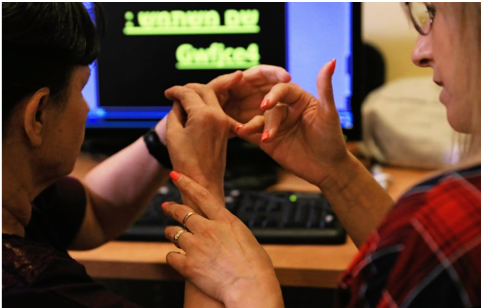
Our Karten CTEC is the only Karten CTEC dedicated to teaching Israelis with deaf-blindness vital computer skills. Thanks to the Ian Karten Charitable Trust 35-40 deaf-blind individuals a year learn skills, via one on one instruction, which make a real and immediate difference in their lives, open up the hearing–sighted world, provide access to information and enable direct, effective and independent communication. Most of our 7 teachers are themselves deaf-blind, deaf, severally visually impaired, or hard of hearing and blind.  One, Rachel, won the Karten Award for Personal Achievement in 2009. Rachel was originally a student at our Karten CTEC and after further training returned as a teacher. She specializes in students with a very basic level of reading comprehension, basic communication skills and limited residual vision.

A man and woman communicating using in hand signing

We’d like to share a few recent stories about her and her deaf-blind students. The events described here were made possible by the equipment that we were fortunate to receive from the Ian Karten Charitable Trust.

Mazal is deaf (from birth), has limited residual vision and is functionally illiterate. Her husband is deaf-blind and is somewhat intellectually disabled. As a result, prior to her studies at our Karten CTEC in Tel Aviv, Mazal was completely dependent on her children for every phone call. She could only communicate independently if she was face to face with the other person.

Studying in our Karten CTEC changed Mazal’s life dramatically. First, she learned how to use an accessible mobile phone and began to communicate independently via video calls and Whatsapp. She uses Whatsapp primarily to send icons, for example a weekly “Shabbat Shalom” (Have a good Sabbath) icon or a “Happy holiday” icon or to send pictures of her grandchildren etc. She was thrilled to be able to independently contact and stay in touch with her deaf-blind friends from our Social Rehabilitation-Recreation Club.  

She also learned how by using a computer she can overcome her limited vision to enjoy cooking and baking videos, surf the internet and more …. These new skills have made a tremendous difference in her quality of life.

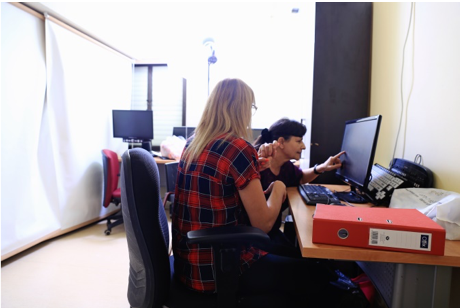
Teacher sitting next to a student working on a computer

Ruthie has Usher syndrome (congenital deafness and progressive loss of vision). She was very independent until a serious car accident left her with half of her body paralyzed and very restricted mobility. After a year of physical rehabilitation she began to study with Rachel at our Karten CTEC. She particularly benefited from learning how to use a variety of services online, including making her own doctors and physical therapy appointments, online grocery shopping and other online purchases. This profoundly changed her life, enabling her to return to and in some ways even surpass her level of independence prior to the accident.    

A third student, Fira, began her studies at home in Jerusalem with a deaf teacher, Tracy. Fira, who like Ruthie (and Rachel herself) has Usher Syndrome. She is a deaf-blind immigrant to Israel and communicates in Russian Sign Language as her primary language and Israeli Sign Language as her secondary language. After she mastered the basics at home and increased her self confidence, she began to study with Rachel at our  Karten CTEC in Tel Aviv. Fira has learned to use a variety of online services. For example, she can now pay her municipal taxes, water bills etc online, including applying for and getting the discounts that she is entitled to receive, The fact that she can do these basic activities independently, and is no longer dependent on her husband, has immensely boosted her self confidence, both overall and as an immigrant. Also, she feels that the ability to directly access services, especially those related to health and social services, enables her to protect her privacy. No longer is she dependent on others to call and/or go to offices for (or with her) in order to get things done. Her new knowledge has also improved cooperation with her daughter’s school, as she can now email the teachers directly, by herself.

These three examples offer a small glimpse into the world of difference that the equipment donated by the Ian Karten Charitable Trust makes in the lives of our students. Thank you!


Technological and Environmental Adjustments for Students with Hearing Disabilities and Cognitive Disabilities

Posted on April 10, 2019 at 12:00 am.

Written by martin

Background

The Support Centre for students with disabilities in the Centre for Academic Equality and Inclusion at Ono academic college (OAC), strive to provide universal technological accommodation based on Universal Design for Learning (UDL) principles, while maintaining a strong commitment to providing students with personal accommodations. The generous fund by the “Ian Karten Charitable Trust” in October 2018, enabled OAC to provide an improved learning environment for a large scope of students with disabilities.

The improvements included:

  1. Acoustic improvements in the support centers’ main office, study rooms and technology room.
  2. Improved sound systems in 14 lecture halls.
  3. Hearing loop systems in 6 lecture halls.
  4. Hearing loop system in 8 service stations.

The devices were installed in two campuses of OAC.

The acoustic adjustments affected the organization at three levels: (i) Direct impact on staff and students; (ii) Increased awareness to students with disabilities and accessibility; (iii) Prioritization of accessibility at management level. Below are two case studies which reflect the impact.

Case studies

“Aisha”

“Aisha”, age 35, is a first-year Management MA student. She has a hearing disability caused by a bacterial infection which erupted at age 31. She uses a hearing aid and, in some cases, needs transcription of lectures.

During the registration process it was important for “Aisha” to understand what supports are available on campus to aid her hearing disability. The fact that OAC had lecturer halls with acoustic improvements and with Hearing loop systems convinced her to register and start studying in our institution.

Hearing loop system in a service station

“Aisha” class was assigned to study in lecture halls with hearing loops and in the acoustic lecture halls. To hear clearly in the acoustic lecture halls, she used a personal FM hearing loop from the technology room. In the courses where she needed transcription, the lecturer used an automatic transcription application. The quality of the sound system and especially the microphones made the transcription more accurate and useful for “Aisha”.

Microphone set in lecture theatre

We were glad to discover that “Aisha” finished her first semester with excellent grades. She also reported high levels of satisfaction from her learning experience and participation and especially her ability to take part in class discussions. This year, there are two more students with hearing disabilities that started learning at OAC following on her recommendation.

 “Michael”

“Michael”, age 43, is a second-year B.Ed. student. He has a paralyzed hand and PTSD – Post traumatic stress disorder, both due to an accident at work. Until the accident “Michael” worked as a coffee machine installer, the accident led him to stop working and begin a long process of rehabilitation. As part of the rehabilitation he decided to turn to academic studies and fulfill an old dream – gain academic education and become an educator.

“Michael” approached the students support center during the first week of the academic year. He reported that he is very distracted during the classes. Because of the PTSD, he feels more comfortable sitting in the back of the hall, and has trouble hearing and understanding the lecturers. Also, he reported that he has difficulties in using the support center. He felt uncomfortable sharing personal information with the consultants and didn’t use the study rooms and technology room because he couldn’t detach himself from the background noises and focus on the conversation and on learning.

Notification sticker for students with hearing disabilities on accessible lecturer hall.

After the installation of the equipment in the second semester of the year, we made sure that “Michael” will study in the acoustic halls. We also updated him about the improvements that were made in the support center and encouraged him to come and study there. “Michael” reported a significant improvement in his learning experience in the lecture halls and in the support center. Before the renovation in the lecture halls, “Michael” almost didn’t attend courses because he felt insufficient while sitting there, and now his attendance has increased. He reports that he can now be in the classroom, sit in the back, hear and understand the lecturers and gain greater understanding of the learning material. Furthermore, “Michael” started studying in the support center. He uses the study rooms and the technology room, where he mostly summarizes study materials using concept-maps applications. His increased presence in the support center enabled a significate professional accompaniment that included personal conversations together with academic mentoring.

Surround speakers mounted on the wall in lecture theatre

A pilot study of automatic transcription in the classroom

Automatic transcription application is a relatively new development that had become more and more common in recent years for free personal use in apps on the smartphones, tablets and computers. Actually, it is known also as voice recognition software. These transcription programs convert speech into text transcripts for use in other applications.

In the field of Assistive Technology, we all know the Dragon Dictation which was one of the first software that had been developed by Nauace more than 20 years ago, however unfortunately until about five years ago it had no Hebrew support.

During the last year in the OAC, we carried out a pilot study trying to use Automatic transcription in the classroom during online lectures for students with hearing disabilities (like Aisha, who is described above) and for students with dysgraphia who can’t take notes during the lecture. The lecturer uses a wireless microphone (which is a part of the sound system) that connect to a computer with Automatic transcription software, and the lecture is transcribed online to a word document. We had tried two types of automatic software – “Koldan” and an internet free software base on google speech to text engine (https://speechnotes.co/).

The pilot study showed us that voice recognition software are not yet performing at the same level as human transcriptionists, it depends on the quality of the microphones, and the accuracy in Hebrew, which is still not good enough, therefore the transcribed output needs editing. We continue with this pilot because we know that the technology is improving by frequency of using and in some cases, it might be cost effective for the students

Summary

In this article we have demonstrate the technological and environmental adjustments for Students with Hearing Disabilities and for Students with Cognitive Disabilities at the Ono Academic College that were implemented thanks to the generous contribution by the “Ian Karten Charitable Trust”. The use of acoustic adjustments were presented in two case studies and in addition a short report of a pilot study about Automatic transcription in the classroom that has been used for students with dysgraphia. In the future we would like to expand implementation of adjustments and automatic transcription to all campuses of OAC and to purchase more technologies, which can improve the studying experience and the accessibility of learning materials to a wider range of students with disabilities.


  • Website Feedback
  • Site Map
  • Cookies
  • Accessibility
  • Privacy
  • Data Protection Policy
  • Disclaimer

© 2026. Karten Network

We use cookies on our website to give you the most relevant experience by remembering your preferences and repeat visits. By clicking “Accept All”, you consent to the use of ALL the cookies. However, you may visit "Cookie Settings" to provide a controlled consent.
Cookie SettingsAccept All
Manage consent

Privacy Overview

This website uses cookies to improve your experience while you navigate through the website. Out of these, the cookies that are categorized as necessary are stored on your browser as they are essential for the working of basic functionalities of the website. We also use third-party cookies that help us analyze and understand how you use this website. These cookies will be stored in your browser only with your consent. You also have the option to opt-out of these cookies. But opting out of some of these cookies may affect your browsing experience.
Necessary
Always Enabled
Necessary cookies are absolutely essential for the website to function properly. These cookies ensure basic functionalities and security features of the website, anonymously.
CookieDurationDescription
cookielawinfo-checkbox-analytics11 monthsThis cookie is set by GDPR Cookie Consent plugin. The cookie is used to store the user consent for the cookies in the category "Analytics".
cookielawinfo-checkbox-functional11 monthsThe cookie is set by GDPR cookie consent to record the user consent for the cookies in the category "Functional".
cookielawinfo-checkbox-necessary11 monthsThis cookie is set by GDPR Cookie Consent plugin. The cookies is used to store the user consent for the cookies in the category "Necessary".
cookielawinfo-checkbox-others11 monthsThis cookie is set by GDPR Cookie Consent plugin. The cookie is used to store the user consent for the cookies in the category "Other.
cookielawinfo-checkbox-performance11 monthsThis cookie is set by GDPR Cookie Consent plugin. The cookie is used to store the user consent for the cookies in the category "Performance".
viewed_cookie_policy11 monthsThe cookie is set by the GDPR Cookie Consent plugin and is used to store whether or not user has consented to the use of cookies. It does not store any personal data.
Functional
Functional cookies help to perform certain functionalities like sharing the content of the website on social media platforms, collect feedbacks, and other third-party features.
Performance
Performance cookies are used to understand and analyze the key performance indexes of the website which helps in delivering a better user experience for the visitors.
Analytics
Analytical cookies are used to understand how visitors interact with the website. These cookies help provide information on metrics the number of visitors, bounce rate, traffic source, etc.
Advertisement
Advertisement cookies are used to provide visitors with relevant ads and marketing campaigns. These cookies track visitors across websites and collect information to provide customized ads.
Others
Other uncategorized cookies are those that are being analyzed and have not been classified into a category as yet.
SAVE & ACCEPT