Nuvoic TechAbility Ian Karten Charitable Trust
Skip to Content
login
karten Network Logo

Supporting organisations working with disabled people

  • Home
  • About Us
    • Introduction
    • Trustees
    • Support Team
    • Minutes of Board Meetings
    • Karten Centre DVD
  • Research
  • Centres
    • Karten Centre Search
    • All Centres
    • Eire
    • England
      • East Midlands
      • East of England
      • London
      • North East
      • North West
      • South East
      • South West
      • West Midlands
      • Yorkshire and The Humber
    • Israel
    • Northern Ireland
    • Scotland
    • Wales
    • Success Stories
    • Equipment Donation
    • Apply for support
  • News
    • Newsletters
  • Resources
    • Mobile Technology Resource
    • eSafety
    • Useful links
    • Webinars
    • Talent and Technology Report
    • Audio Books
    • Event Handouts
  • Job Vacancies
  • Events
  • Contact Us
  • Home
  • About Us
    • Introduction
    • Trustees
    • Support Team
    • Minutes of Board Meetings
    • Karten Centre DVD
  • Research
  • Centres
    • Karten Centre Search
    • All Centres
    • Eire
    • England
      • East Midlands
      • East of England
      • London
      • North East
      • North West
      • South East
      • South West
      • West Midlands
      • Yorkshire and The Humber
    • Israel
    • Northern Ireland
    • Scotland
    • Wales
    • Success Stories
    • Equipment Donation
    • Apply for support
  • News
    • Newsletters
  • Resources
    • Mobile Technology Resource
    • eSafety
    • Useful links
    • Webinars
    • Talent and Technology Report
    • Audio Books
    • Event Handouts
  • Job Vacancies
  • Events
  • Contact Us

Royal Society Launches Landmark Disability Technology Report

Posted on July 17, 2025 at 12:07 pm.

Written by martin

I had the privilege of attending the Royal Society’s launch of its Disability Technology report last month, a thought-provoking and, at times, deeply personal event that brought together policymakers, technologists, researchers, and disabled people to reflect on where we are and where we need to go.

Martin Pistorius in a light blue shirt takes a selfie outside a grand cream-colored building with tall windows and black railings. The sky is blue with scattered clouds. The setting is The Royal Society in London.

The evening opened with powerful remarks from Professor Alison Noble, who reminded us that disability is a universal human experience, something every person will encounter in some form over their lifetime. That perspective was carried through the evening: disability not as an exception, but as part of what it means to be human.

It began with time to explore a range of fascinating exhibits, from the Google Accessibility Discovery Centre, EyeHarp, and Waymap, to Auracast, Blind Ambition, and an immersive installation by artist Christopher Samuel. There was also space to connect with others working across disability and technology, and to pause and reflect on the scale and depth of the challenges ahead.

A panel of six speakers sits on stage at The Royal Society during the launch event for the "Disability Technology" report. Behind them, a large screen displays the report’s title and tagline: "How data and digital assistive technologies can support independent, fulfilled lives." A QR code and Wi-Fi information are shown, and the vibrant background features glowing neural-like imagery in purple and pink tones, also seen on the report cover displayed on the right.

This was followed by the formal launch of the report, beginning with a short film and a presentation outlining its key findings. A powerful panel discussion rounded out the evening, offering diverse perspectives on the current state of disability technology and where we need to go next.

At the heart of it all was the report itself: Disability Technology, the result of two years of research, including interviews with 800 disabled people, 2,000 members of the public, and insights drawn from the UK, US, India, and Kenya. If you missed the event, I encourage you to watch the recording, or explore the full report. For those who find listening easier, an audio version is also available.

The report makes a clear and compelling case that disability technology isn’t, and nor should it be, an afterthought. It is a core part of digital inclusion, economic participation, and innovation. It calls for better data, more inclusive design, and greater investment in assistive technology.

One recommendation that especially stood out to me was the call to recognise smartphones as assistive technology, on par with hearing aids or white canes. As someone who uses mobile tech every day to communicate, access information, and navigate the world, I was pleased to see this acknowledged. I’d love to see this extended to tablets as well. For many people, especially those using devices like the iPad with alternative input methods or larger screens, they’re no less vital.

Another theme that resonated was the role of policy. One panellist observed that digital exclusion is not just a failure of design, it is a failure of policy too. Designing for inclusion is not enough if the systems around that design don’t support access, funding, or awareness.

A panel discussion at The Royal Society on Disability Technology, with six speakers seated on stage beneath a projected slide listing their names. A British Sign Language interpreter stands to the left, mid-gesture. The screen behind them displays the event branding and a visual of neural-like digital art. Live captions are visible above the slide.

Professor Annalu Waller closed the evening with words that lingered long after the panel ended: “We need to inculcate in every person the understanding that disability is not abnormal, but part of being human. Everyone, at some stage, will be disabled. So we need to give them a voice and not write them off.”

There is still a long road ahead, but this felt like a significant and hopeful moment, not just in highlighting challenges, but in pushing the conversation toward action. The Royal Society and others have stressed that we must now reframe how we value assistive technology, recognising its role in everyday life, not just as specialist tools, and ensuring equitable access through inclusive research and policy. The report also emphasises that disabled people must be meaningfully involved from the outset of any design process. The challenge now is to ensure that momentum carries forward, that disability technology is not just discussed, but prioritised, invested in, and embedded across the digital future.

Martin Pistorius
Karten Network Technology Advisor


Assistive Technology Week – Limitless by Inclusion

Posted on July 16, 2025 at 11:50 pm.

Written by martin

Three people smiling for a selfie indoors. The person on the left is holding the camera, while the woman in the middle holds a small blue model or object. A third person stands to the right. Behind them is a purple backdrop and part of a classroom or activity space.

We just wrapped up our Assistive Technology Week – Limitless by Inclusion, which concluded on a positive note with a small exhibition attended by visitors, staff, and students. Throughout the week, we experienced peak moments (Thursday) and some less favourable ones (Monday), along with instances where technology felt more like an adversary than an ally. Despite these challenges, the overall response was positive, and we’re certainly planning to host this event again next year.

Several people interact with a large interactive tabletop display, which is lit with colorful projections. The table is set up in a classroom or lab setting with computers and monitors in the background. Participants are using their hands to engage with the projected content.

The online event on Wednesday worked well with eight different presentations and participants from Loughborough University, parents and other Colleges.   Presentations included using virtual reality to teach different communication skills from Bodyswaps, music, and assistive technology, and Microsoft accessibility options, plus information about using AAC devices from Sense College’s Speech and Language Therapist.

The two live events featured stalls from several different technology companies, including Everway, Aventido, and Thomas Pocklington Trust, plus in-house stalls for MSI Technology and AAC.  There were a few speakers who gave short presentations about a range of topics, including an introduction to what AAA stands for and a little bit about Techability. 

Two women converse at an informational booth for Avenida, an assistive technology community. The booth table is covered with brochures, business cards, and a laptop, and features a banner inviting people to join the Avenida AT Community. The setting appears to be an indoor event space with large windows and other attendees visible in the background.

The final presentation was by Sense College student technology champions (Adam B, Ben C, Ben P, Esma O, Theo L) and from Kingsley Saba about what “Limitless by Inclusion” actually means.  Kingsley spoke about how our students use assistive technology in College, and about the challenges that people may face when using assistive technology, including funding AT, lack of awareness, and societal stigma.  Kingsley identified that these challenges can be resolved through partnerships with technology firms and charities, by attending events to enlighten ourselves on the potential of AT and training on how to use AT.  The visitors to these events were from different FE Colleges, parents, staff and students.

I thought I would finish off with an excerpt from the Champions’ powerful presentation. 

“We’re the Assistive Tech Champions, and today, we’re not just sharing our stories—we’re inviting you to join a movement.  Imagine trying to fit a round peg in a square hole. Well, that is how it feels when learning and other activities are not inclusive.

We as the champions are here to put an end to this by making it known to everyone what the challenges are and how Assistive Technology empowers everyone to make an inclusive society.

Adam – I use Assistive Apps like Seeing AI, and Talkback on my phone that helps me to do everything on my phone like access Google Maps for mobility purposes.

Ben C – I am proud to demonstrate how my technology works.  It helps me to communicate with my tutors and do other things which I won’t be able to do if the environment is not inclusive.

We believe raising awareness on the potential of assistive technology is a good starting point to develop a truly inclusive society.

People ask, ‘What does “Limitless by Inclusion” mean?

It means my wheelchair isn’t a ‘limitation’—it’s my freedom.
It means my AAC device isn’t ‘special’—it’s essential.
It means our differences aren’t barriers—they’re blueprints for a better world.”

So, this week, we challenge YOU – Try a tool you’ve never used. Ask us questions. Make a pledge.  Because when you embrace inclusion we all become limitless.  Thank you for believing in our vision. Now let’s build that future—one switch, one click, one voice at a time!”

Five young people wearing matching purple "Assistive Tech Champions" T-shirts pose in a classroom. Two are standing, while three use wheelchairs, one of which includes a mounted communication device. Behind them, a large screen displays a travel website showing a resort with a pool and the word "TIVOLI." The room has white brick walls, a red chair, and a coat hook on the wall


TechAbility Conference 2021

Posted on October 11, 2021 at 11:26 pm.

Written by martin

laptop open on a table displaying the text "Join us for #TechAbility2021"

The TechAbility Conference is always focussed on assistive technology practice which makes a difference for people with disabilities.  This year the conference is online and Karten members receive a significant discount on the attendance fee.  What’s more, one fee will cover multiple attendees from your organisation.

You can expect to hear first-hand experience of assistive technology use, alongside a real “back to basics” focus on how it can overcome barriers. You will leave with a greater focus and understanding, led by the best practitioners in the field and carefully curated to keep sessions lively and relevant.

The interactive keynote  will be especially interesting to Karten Centres, focussing on the role of technology for disabled people in care settings. Julie Eshleman from Leonard Cheshire is researching meaningful technology use and would like the people you support in Karten Centres to come along to her keynote session and share their opinions.

Other highlight sessions include:

  • How disabled people and carers/PAs use virtual assistants
  • The difference the right AT can make
  • Developing your own apps
  • The right technology supporting the learning journey

The full programme is available on the TechAbility website where you can also book your place.

For any questions please contact techability@natspec.org.uk


TechAbility – Standards & conference resources

Posted on December 11, 2019 at 8:08 pm.

Written by martin

TechAbility Logo

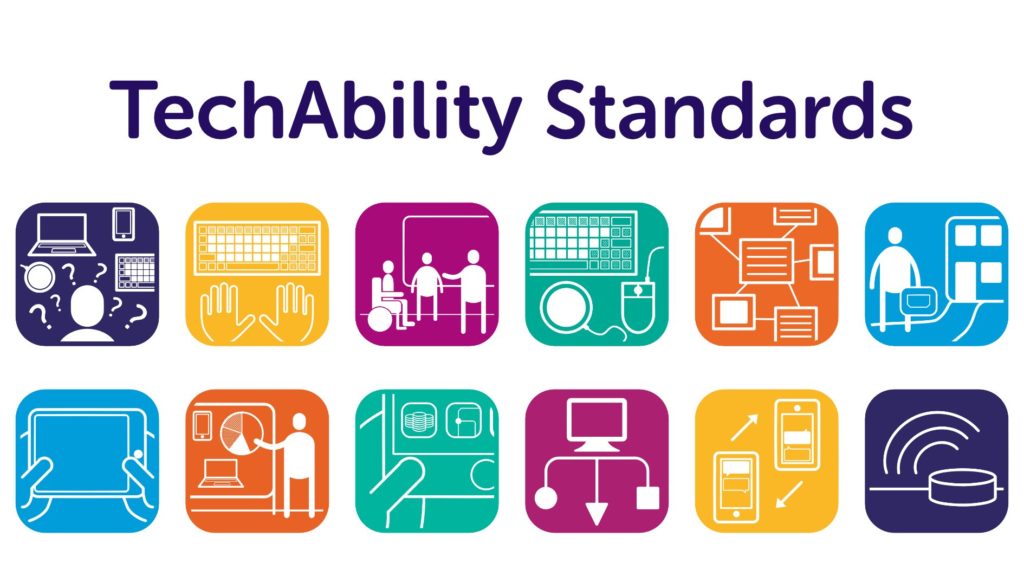
TechAbility Standards

“Outcome Driven Technology”

Various colourful icons representing the TechAbility Standards

TechAbility has been working with Natspec Colleges and Karten Centres to improve the standards of Technology. This has been achieved through delivery of webinars, consultation visits, seminars and events.​

​One of the key findings during this time is the lack of guidance around what colleges/centres should be striving towards. There is an understanding that technology should be used, but without a clear view of how it should be used and to what ends.​

For this reason we created the TechAbility Standards.

How to use them:

  • Starting point to improve technology use​
    Audit tool or inspiration in an understandable format
  • ​Understanding how TechAbility can improve educational outcomes​
    To encourage targeted and needs-led interventions
  • ​Quality Assurance/Inspection​
    Measuring excellence with technology focused on learner outcomes.

For more information about TechAbility Standards please visit: https://www.techability.org.uk/techability-standards/

TechAbility 2019 Conference Resources

Delegates listing to a presentation at the TechAbility 2019 conference

The TechAbility 2019 conference was held in Birmingham on 21st November.  Delegates found the event to be enjoyable, engaging and though-provoking.  If you weren’t able to go along you can now access the conference materials.

The link below will take you to a page where you can download individual presentations from keynote speakers and workshops.

You can also download a transcript and audio recording of the panel session from: https://www.techability.org.uk/techability-2019-presentations/

The date for TechAbility 2020 will be announced soon – we hope to see you there.

Please get in touch with TechAbility if you require any Assistive Technology training or consultation for your organisation.

Telephone: 0115 854 1322
TechAbility@natspec.org.uk

Assistive Technologist: Neil Beck
neil.beck@natspec.org.uk

Assistive Technologist: Fil McIntyre
fil.mcintyre@natspec.org.uk

Twitter: @Tech_ability1


  • Website Feedback
  • Site Map
  • Cookies
  • Accessibility
  • Privacy
  • Data Protection Policy
  • Disclaimer

© 2026. Karten Network

We use cookies on our website to give you the most relevant experience by remembering your preferences and repeat visits. By clicking “Accept All”, you consent to the use of ALL the cookies. However, you may visit "Cookie Settings" to provide a controlled consent.
Cookie SettingsAccept All
Manage consent

Privacy Overview

This website uses cookies to improve your experience while you navigate through the website. Out of these, the cookies that are categorized as necessary are stored on your browser as they are essential for the working of basic functionalities of the website. We also use third-party cookies that help us analyze and understand how you use this website. These cookies will be stored in your browser only with your consent. You also have the option to opt-out of these cookies. But opting out of some of these cookies may affect your browsing experience.
Necessary
Always Enabled
Necessary cookies are absolutely essential for the website to function properly. These cookies ensure basic functionalities and security features of the website, anonymously.
CookieDurationDescription
cookielawinfo-checkbox-analytics11 monthsThis cookie is set by GDPR Cookie Consent plugin. The cookie is used to store the user consent for the cookies in the category "Analytics".
cookielawinfo-checkbox-functional11 monthsThe cookie is set by GDPR cookie consent to record the user consent for the cookies in the category "Functional".
cookielawinfo-checkbox-necessary11 monthsThis cookie is set by GDPR Cookie Consent plugin. The cookies is used to store the user consent for the cookies in the category "Necessary".
cookielawinfo-checkbox-others11 monthsThis cookie is set by GDPR Cookie Consent plugin. The cookie is used to store the user consent for the cookies in the category "Other.
cookielawinfo-checkbox-performance11 monthsThis cookie is set by GDPR Cookie Consent plugin. The cookie is used to store the user consent for the cookies in the category "Performance".
viewed_cookie_policy11 monthsThe cookie is set by the GDPR Cookie Consent plugin and is used to store whether or not user has consented to the use of cookies. It does not store any personal data.
Functional
Functional cookies help to perform certain functionalities like sharing the content of the website on social media platforms, collect feedbacks, and other third-party features.
Performance
Performance cookies are used to understand and analyze the key performance indexes of the website which helps in delivering a better user experience for the visitors.
Analytics
Analytical cookies are used to understand how visitors interact with the website. These cookies help provide information on metrics the number of visitors, bounce rate, traffic source, etc.
Advertisement
Advertisement cookies are used to provide visitors with relevant ads and marketing campaigns. These cookies track visitors across websites and collect information to provide customized ads.
Others
Other uncategorized cookies are those that are being analyzed and have not been classified into a category as yet.
SAVE & ACCEPT