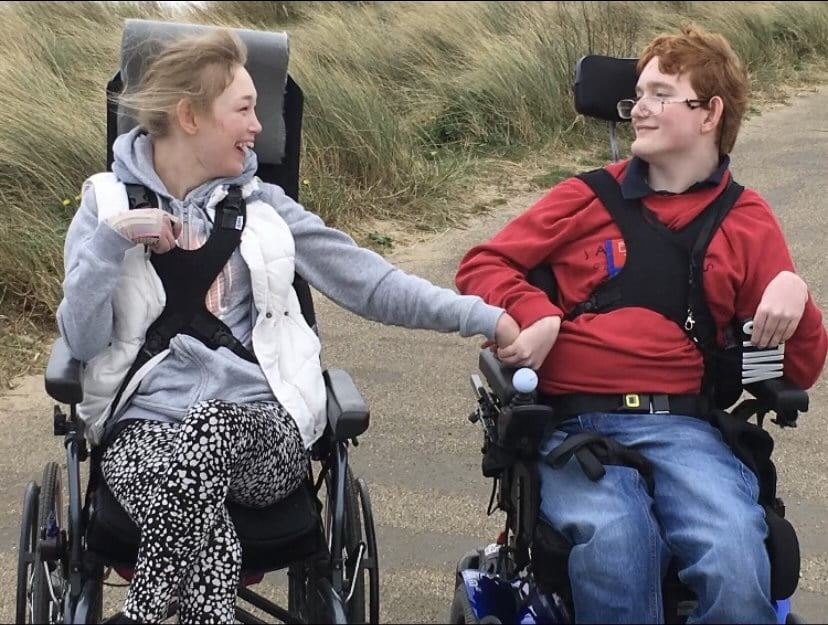
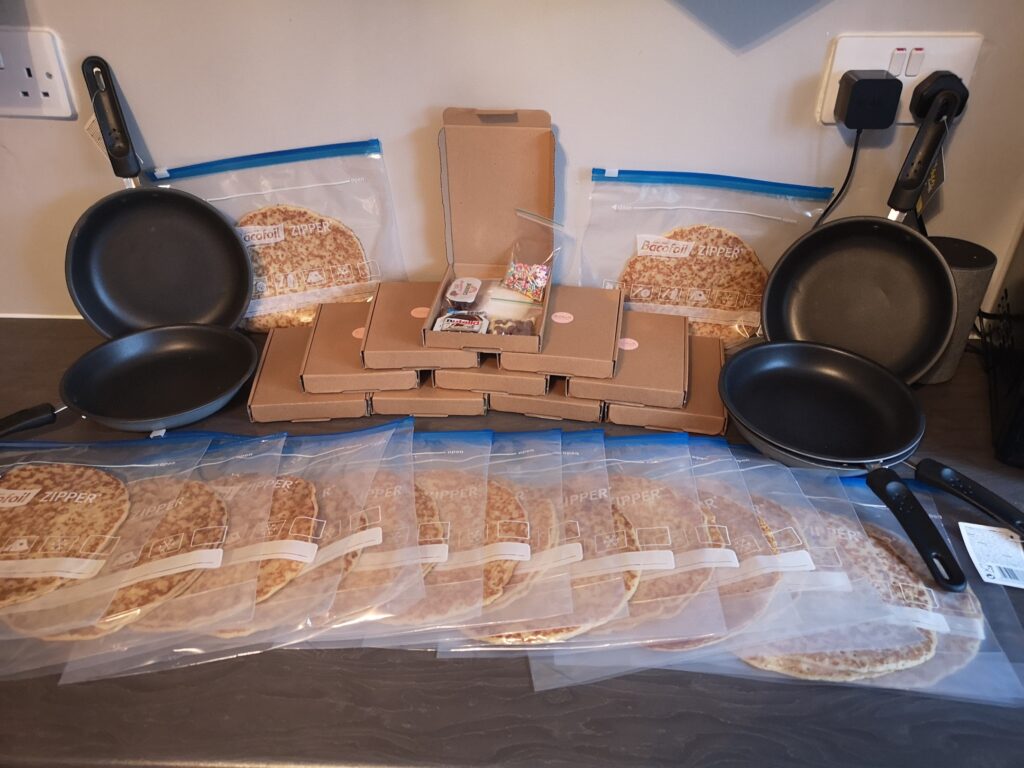
Orchardville Works participants and staff are glad to be back at work and have been working hard as always, even under strict covid restrictions. We have sourced and branded our own sanitiser packs that provide activity for our participants as well as ‘on the go’ covid protection for the recipient. The branding on these bags (whether heat pressing or embroidery) was made possible by the generous donations from The Karten Network and equipment purchased from these funds. These corporate packs have proven popular with various Northern Ireland companies as we have the ability to include their corporate brand.
We have expanded our product range and introduced an online selling option at www.orchardvilleworks.com providing seasonal personalised gifts and treats alongside our Worthy range.
As part of the development of our TV station we were delighted that Sir Lindsay Hoyle Speaker of the House of commons agreed to be interviewed. The interview took place in November and our members thoroughly enjoyed the experience.
Now in 2022 we are involved in The St Helens Oral History project. Our media team over the next twelve months will be filming / Interviewing and recording individuals life storys and memories. We have looked to develop members skills and confidence with a range of different people to interview from all walks of life. Our work will be held within the local archive at the end of 2022.
Liverpool City Region Culture and Creativity Awards 2021
In January we were informed that we had been selected as finalists for the Liverpool City Region Culture and Creativity Awards 2021. The category being “The impact Award – Covid 19 Creative response ( Organisation)”.
We recieved the nomination for how we as an organisation we reacted to the lockdowns. Sustaining the service and keeping everyone connected. We moved our service online and we were able to distribute devices to every member who wished to be involved. We distributed around 80 devices and facilitated over 160 session over a calendar month. Read more about this in the “Good news story” article featured in the Spring 2021 newsletter.
The Awards ceremony will be held on the 2nd March 2022.
Buzz Hub Portal
In this video people share there experience using the Buzz Hub Portal during lockdown.
The Maples bungalow had always been a place for learners to develop their independence skills, although over time has become worn and outdated.
Our Karten trust funding to revamp and repurpose the Maples into a Smart Home provision helped us to modernise and consider purposeful, meaningful opportunities using a range of assistive equipment.
Once our bid was approved by the Karten trust board we furnished the Maples Bungalow with equipment that would give learners the opportunity to meet their outcomes.
Maples office
To enable learners to develop their independence; the use of voice technology was the main purpose of the development.
The Smart Home was zoned into 5 spaces: kitchen, lounge, chill-out room, bedroom and office.
Each room offering a different experience.
Maples chill-out room
Using the Alexa Dot, Alexa show and Samsung SmartThings apps with equipment such as: robotic vacuum, televisions, heating, blinds, lights and lamps, bubble tube, washing machines, fridge and door cameras; learners have been able to control the environment, develop communication skills, problem solve, follow instructions and develop their independence skills in a functional home setting.
Currently 40 learners over 5 days have access to the Smart Home.
Some sessions are led by the Speech and Language Therapy Team. This statement has been provided by the Speech and Language Therapy Team:
“The speech and language therapy team have been running sessions with groups of learners in the Maples Bungalow each week.
These sessions have been focusing on functional communication skills to support real-life activities e.g. making a drink, cleaning the kitchen.
The bungalow provides creative and unique opportunities to support learners with different needs. For learners with physical/access needs who cannot complete household tasks independently, sessions have focused on using language to instruct Alexa or another person to do a task e.g. instructing Alexa to turn the kettle on or instructing another person to get a mug from the cupboard. This allows these learners to be active participants in their household activities.“
For those who communicate using AAC devices, learners were taught to use their device to speak to and control Alexa. A range of commands were taught, including changing the lights, turning on/off the vacuum cleaner and turning on the kettle. This was often incredibly motivating for learners, who quickly learnt that their AAC ‘voice’ has the power to change and manipulate the environment.
Speech and language therapists often face challenges concerning the retention and generalisation of skills which are taught within therapy sessions. The Maples Bungalow provides the opportunity for taught skills to be practiced in a home setting, allowing for generalisation practice to occur on campus. To support carryover of skills further, resources and strategies which were learnt in the bungalow are sent home for further practice and application.” – Speech and Language Therapy Team Portland College
Case Study – AAC Tutor
George came to college last year with an eye gaze communication device and Grid 3 software. He has since undertaken a weekly AAC/SLT session and is making progress.
George has had varying topics programmed to his device to encourage his communication. Topic that have been added relate to his interests of football, music, and cause and effect.
At the start of this process George was reluctant to use the device. Over time he has become more engaged, and willing to work with the equipment, choosing from either direct access, eye gaze or modelling from staff.
More recently George has accessed the Maples Bungalow to use the Alexa to control his environment. He enjoys choosing instructions on his device, so that he can control the environment by changing the colour of the lights and opening the blinds.
He particularly enjoys this session, often loudly vocalising when he enters the bungalow. He will direct staff to where he wants to be positioned in the room to ensure he gets the best view of the environmental changes.
With the continued use of the Maples Bungalow it is hoped that Georges motivation to control is environmental will increase and this will lead to developing his communication skills.
Rob changing the lightsOliver checking ingredientsMolly washing the tea towels
“I love using the iPad. I can take photos now myself and look for things on the internet that can help me learn”. – Student
Background
As a result of funding from the Ian Karten Charitable Trust, in March 2021, we purchased 16 iPads and Mac Covers.
The iPads, are based at Kisharon Childs Hill Library in Barnet. The project was initially delayed due to the impact of Covid and the further lockdown in December 2020.
Why were iPads Needed
The iPads were purchased to support the people we support whose day-to-day activities were dramatically affected by Covid.
As much of the world moved on-line it was vital that all the people we support could access work and information.
This proved a challenge for those who are digitally excluded due to their economic circumstances with no access to a computer at home.
The iPads
“With the era of zoom sessions, it has been another way for students to use technology to become independent and reconnect with others. We have seen students learn how to log onto zoom with a meeting ID and passcode, set up a meeting and heard that this skill has been used at home too by students in order to attend social events in the evenings during the height of the pandemic”.– Aviva Braunold , Project Manager
iPads have been purchased from our preferred supplier Marsworth Computer Network Support Specialists.
The iPads include easy-read programmes which are simple to operate, and helped assist the people we support in accessing information independently.
Many of our young adults have required the iPads to be pre-loaded with religious restrictions on internet usage and with activities and college work.
How the iPads have helped the people we support
Since purchasing the iPads our young people have developed a range of skills that has enhanced their independence and prepared them for future employment opportunities.
We have supported them to plan and take control of their day by creating personal plans which includes reminders of when to do particular activities.
One particular area, where young people have benefitted which was unanticipated at the time of the application was using the iPads for recording and registering Lateral Flow tests.
“Now I know how to look up recipes on the iPad I can do it on my phone at home. I will make this (pizza) for my family. It’s so good!”– Service user
One service user wanted their friend to come and have a tour of the college but as it was during lockdown, visitors were not able to come into the setting. Instead, he learnt how to set up a meeting, send an email with an invitation on and invites his friend to a virtual tour of the college.
The tour allowed him to take ownership of the activity as he was holding the iPad and showing his friend around the college whilst explaining what each room was used for.
This was a great example of using technology to enable him to communicate with others whilst learning new IT skills which he could later use in other parts of his life.
We also had a baking session for all people we support across different parts of the service which had to be moved to zoom due to the pandemic.
One of the young people led this session by logging onto the zoom account, muting and unmuting people and using his iPad to host the session and show others how to bake a cake. The other people we support followed his instructions and made the cake with him in their own homes at the same time.
How the iPads have helped the people we support
We have observed the following increases in outcomes for the people we support from some of the activities listed below:
Online shopping → Enhanced numeracy skills
Looking up and learning travel routes to get around and making social plans like meeting up with friends Increased independence → Increased independence
Reminders of when to take medication → Increased independence
Browsing the internet and using apps → Increased literacy
Keep a photographic journal of their week and share this via a secure network with family, peers and support workers → Enhanced communication
Watching music videos → Increased social skills
Thank you very much once again for your support, we hope you have enjoyed reading about our work
ESPA College opened in 1995 and has four college sites across the North East, providing day and residential education for young autistic people between the ages of 16 and 25 years. The majority of students have additional and complex needs including learning disabilities, ADHD, mental health conditions, behaviours that challenge and sensory issues.
Their South Hill site, located in Sunderland, provides personalised learning programmes to autistic and neurodiverse individuals, some with moderate to profound learning disabilities.
Over the summer of 2021, ESPA College South Hill was granted funding and official Karten Centre status and saw the successful installation of a brand-new Sensory Room.
Sensory needs of students can be a barrier to their education, and as everyone deserves access to education, the installation of this state-of-the-art sensory room supports students to manage their sensory needs, making it easier to focus and participate in lessons and community activities.
The space was created in collaboration with Mike Ayres Design and college staff. The team chose a suitable space in their building, and selected the very best equipment, to meet the complex sensory needs of their students.
The Sensory Room features:
Large bubble tube
Rainbow light bar
Tactile cause and effect wall panel
Sound and light wall panel
Interactive fibreoptic unit
Sensory projector
Sparkle cloud
Integrated audio and visual system
The Sensory Room has been constructed to give the users direct control of the equipment via an iPad or the nine-switch keyboard, and can be used as an interactive learning environment, or a quiet relaxation area.
Students and Social Hub Members have returned to college for the Autumn term and have already provided some positive feedback on their new sensory room. ESPA College look forward to sharing this fantastic resource with all ESPA services.
Quotes from students:
Jirapat says “I like the bubble tube, it makes me feel relaxed”
Charlie says “I like the lights and relaxing music”
The team at Treloar’s has been celebrating the 20th Anniversary of TreloarPrint, the in-house printing enterprise at the College!
TreloarPrint, the original Ian Karten Centre at Treloar College was set up in September 2001 thanks to generous funding from the Ian Karten Charitable Trust, to provide a real working environment for students. Since then, the enterprise has gone from strength to strength delivering 2,000 jobs per year, employing former students and supporting many others into work outside Treloar’s.
TreloarPrint can provide all manner of printed products, support with mail shots where appropriate and design artwork. Over the last 20 years the enterprise has amassed a strong supporter base and a great reputation with many clients working with them since the beginning.
“I have enjoyed using Treloar Print for many years as they are absolutely first class in not only the quality of print but in service from both the print technicians and the students that work there. Everyone is incredibly helpful and friendly.” Kate Davis
As well as providing a high quality print and design service, TreloarPrint allows students to gain work experience in a safe environment to enhance their work-based understanding, team working and problem solving. This supports students to go on to other work experience opportunities with confidence. Where TreloarPrint continues to employ ex-students of Treloar School and College these staff act as key role models for current students.
Whether acting as the receptionist for TreloarPrint, taking incoming calls from customers, preparing quotes and seeing a print job through to completion and delivery, students are actively engaged in a spectrum of job roles. During their time at TreloarPrint students develop communication and independence skills, literacy, ICT, numeracy, and other employability, practical and social skills.
These work experience opportunities both prepare them for life beyond Treloar’s at the same time as building their confidence and self-esteem as they put the skills they have learnt at Treloar’s into practice.
Aaron Dyer, former TreloarPrint work experience student, went on to gain employment in the local area. Since then his career has blossomed and he’s now back at Treloar’s in our Administration team. He said; “As a former student it’s wonderful to see TreloarPrint still thriving 20 years later providing a wide range of services to the local community.
The ‘real world’ work experience I gained as part of the initial group of students to access the equipment provided by the Ian Karten Network prepared me to access the workplace after leaving Treloar College in 2003.
I believe I would not have been able to return to work at Treloar’s as an Office Administrator if the IKC hadn’t been introduced in 2001.”
The TreloarPrint team can’t wait to see what the next 20 years bring, and would like to thank the Karten Network for so generously supporting the Centre in this time.
Happy 20 years to everyone involved in TreloarPrint!
This year Langdon College has launched Langdon College Prints on the ‘Etsy’ marketplace. This is an online shopping platform where we will be selling our enterprise products UK wide.
Previously learners were making and selling items at local stalls/events but sadly due to Covid this all had to stop. This new way of working will provide learners with a work placement whilst providing an opportunity to develop a higher level of skills in ICT and business.
Currently the Etsy Shop sells our core range of products but the learners are in the process of developing new ideas and lines that will be available soon.
All the equipment used to create the products has been funded by the Karten Network.
As we get older our bodies go through inevitable changes and some daily tasks can become harder to perform. For some people this includes the use of hand-held devices and a perhaps laptop and desktop technology too. Even older people who are well-versed in home technology may suddenly find their devices becoming more difficult to use as their physical needs change.
Visual or cognitive impairment can be considered the dominating factors that contribute to difficulties when using devices, but it is the deterioration in the use of aspects of one’s hands that can be a true obstacle – both to hold and to function. Osteoarthritis and Parkinson’s Disease can cause such impairments and lead to the loss of a strong grip, painful wrists (arthritis), compromised tactile actions and overall deterioration in dexterity thus make the use of handheld devices particularly difficult.
Fortunately, over the years mobile phone manufacturers have adapted their phone designs to accommodate the needs of the older generation and it is possible to change the settings or source equipment that meets peoples’ needs. For example, to avoid manual dialling, phones offer voice calling, hands-free loudspeakers, lightweight casing, haptic feedback (when you press a key, the phone vibrates to avoid making a mistake when dialling), keypads with well-spaced buttons, vibration alert (to know when a call or message is being received) and shock/water/dust resistant casing – in case of a device being dropped.
Welcome, too, the tablet. Tablets have become a favourite with older people. It is an ideal device as its larger surface area aids with hand difficulties as the touch engagement of a tablet versus a smaller device such as a mobile phone, is considerably easier. Additionally, tablets are mostly light in weight compared with a laptop and thus easier to hold and transport. Usefully these days, tablets now have the same general capabilities as the average smartphone.
Any endeavours that allow older people to stay independent longer in the comfort of their own environment should be embraced even if it means adapting devices to meet their specific needs, especially signs of deteriorating hands for which much assistance exists, including from an Occupational Therapist who specialises in helping people to adapt themselves to their changing needs and ensures that they can continue carrying out everyday tasks.
SeeAbility launched our Supported Employment programme because we know that around 65% of people with learning disabilities and sight loss want meaningful careers but only 6% are in paid employment.
“My name’s Emily. A lot of people thought I would never get a paid job. But I proved everyone wrong.”
We support people to realise their full potential and move into work. Fulfilling career ambitions is a hugely important part of this.
We draw on over 220 years of experience to support people with learning disabilities, autistic people and people with sight loss, helping them achieve extraordinary things and crucially, to realise their ambitions around paid employment. At the heart of Ready, Willing and Able is inclusion, with the person always at the centre of the programme. The programme also gives employers the opportunity to recruit enthusiastic and talented individuals who will become valued employees.
We have developed a central hub of information for both participants and employers to find out all about the RWA programme, pioneering new accessibility options not commonly seen on other websites, such as easy read online content.
We also have dedicated Supported Employment coaches who work with participants to support them in building skills and confidence and to help them to find roles that they are interested in, and collaborate closely with the Creating Connections programme to provide digital upskilling for participants (where required).
Our coaches also work with employers to support their knowledge and confidence, so that they can provide accessible application forms, interviews and an accessible working environment once a candidate has been placed.
Since March 2021, we have set up several successful pathway partnerships, and have 17 participants meeting with a coach on a weekly basis developing their employability skills and actively applying for roles.
To learn more about how SeeAbility is promoting digital inclusion, check out Creating Connections and our resources. If you would like to hear more about how you could get involved with our Ready, Willing and Able programme please visit: https://www.seeability.org/supported-employment
John lives on site at The Meath and while he enjoys the variety of activities on offer at our dedicated Skills Centre, he has a natural leaning towards and interest in IT. He is fascinated by how things work and has huge capacity for finding out more about topics of interest, having spoken to John it is apparent that using the Skills Centre IT suite is a huge source of life enrichment. While John is happy to celebrate success made at the gym, he gains much of his sense of purpose and achievement from his progress in IT sessions which combine research, literacy, communication, design, and IT skills. The process of working on these projects helps him to maintain cognitive function, while typing helps to maintain his fine motor skills. John uses standard equipment and Microsoft word. He can work from a regular keyboard and screen; we support clients with a broad range of abilities and needs and many of our less able users require larger keyboards to work from in addition to specialist software, for clients who are visually impaired.
John has carefully and methodically been supported to produce three detailed research ‘how it works’ topic books on subjects of his choosing, these are: the Honda Car, the Television and the Denis bus (both motorised and electric). John’s research was enhanced by visits to Brooklands transport museum (home to the national bus museum) and even a trip to PC world is a source of great fascination and information for him.
The pandemic and many lockdowns have been an especially challenging time for many of the people we support and for John, having access to the IT suite was a huge factor in him maintaining good mental health during lockdowns. John has achieved much of his latest research book during lockdown periods and it gave him drive and focus during a difficult time.
John is extremely grateful to have easy access to the equipment on site and his two IT sessions are always the highlight of his week. He has set his sights on a new project book about The Hovercraft and plans on taking the Hovercraft on a day trip to the Isle of Wight for some field trip research. As John is also a keen and skilled photographer, he hopes to use some of his own photography in his next project. One of his learning objectives is also to use IT to prepare some presentations about his research topics; here IT will be utilised to enable John to improve in communication and presentation skills which is are areas that he feels less confident in.
Now that the IT sessions take place outside of lockdown, Activity Leader Rachel hopes to introduce some video editing software to enable the group to create their own short videos which explain and celebrate the progress they have made in IT or other sessions.
Treloar’s are lucky enough to have two Karten Centres based at Treloar College. One is known as TreloarPrint and provides a real life working print shop for internal and external customers where students can gain important work experience and learn business skills. Students within the Centre are working towards their City & Guilds NVQ in Business and Administrationqualifications and other students also attend the Centre for work experience placements ensuring a wide range of Treloar’s students benefit. Amelia (pictured) has recently undertaken a work experience placement in TreloarPrint where she has been getting involved in using different software on the computer, printing cards for a customer and learning about the vast paper stock. Work experience opportunities both prepare the students for life beyond Treloar’s at the same time as building their confidence and self-esteem as they put the skills they have learnt into practice.
Gaining future supported employment can be hugely challenging for our students given their complex disabilities. However, we were really pleased to be able to offer Samantha the job of receptionist in TreloarPrint nearly 3 years ago now, after being a student in the Centre some years previously. Samantha (pictured) gained the job on merit and is really flourishing in the role. As well as her job as receptionist Samantha is now mentoring some of the students in the Centre to boost their confidence and communication skills and help them feel more positive about their next steps after Treloar’s. Samantha is just one of many wonderful success stories to come from the TreloarPrint Karten Centre and we have no doubt there will be many more to follow.
The second Karten Centre is called Treloar Enterprise Printing Solutions (TEPS) which provides high quality printing solutions, to business and the local community, on mediums such as china, textiles and paper. We were delighted to be awarded funding from the Karten Network in 2020 to purchase new direct to garment and wide format printer and a replacement sublimation printer.
The direct to garment printer (DTG) has been a revolution. DTG printing is the process of using a modified inkjet printer to apply digital designs directly to fabric. As opposed to using sublimation paper and inks to transfer prints onto materials. The sublimation process is much more labour intensive and the majority of the work cannot be undertaken by our students due to the nature of the equipment and the risks involved with the high temperatures of the heat press and the difficulties operating the heat press itself. Although the DTG printing process still involves heat pressing the rest of the process can be done by our students. The excellent software enables them to make edits to images, line them up correctly on the garment that they are printing to and then start the printing process. The only help required at this point is to place the garment/fabric onto the printer platen. Enabling students to be a part of the actual printing process, encouraging and enabling them to use their IT skills is such a step forward. As we move further out of COVID-19 restrictions more of our TEPs students will be able to take part in the production side of things. One of our students is going to be starting work experience in September and he will be assisting with DTG printing, which he is delighted about as are we.
Our biggest order to date has been to produce 120 prints onto canvas bags for our outdoor learning centre. There was a design competition and the three winning designs were then printed. The runner up design of a hedgehog has proved most popular with staff and visitors and we are still taking requests for these. Again the beauty of the DTG printer and software is it is as easy to run off one design or a 100, which means even small orders can be turned around really quickly. The quality of the print is superb and needless to say all students and customers are delighted.
The Canon Photo printer again has not been utilised as much as we would have hoped due to COVID-19 however since the start of the summer term we have been up and running again, producing prints for staff and teachers. To date, it has been used to produce our students Silver Arts award photos and large scale Beebot Mats and Board games that are used to support the curriculum. The graphics and print quality is absolutely outstanding so we know that once we are printing for customers they too will be as delighted with the results.
Once again the ease of use means that some of our students are able, with minimal support to change the paper roll, and to get designs printing. The old printer was inaccessible due to the height of the machine, and complexity of loading paper. With its self-feed all that is required is a little help from a member of staff to assist the student loading the roll into the machine, the rest of the set up process can be controlled by the students. The wide range of materials that we purchased as part of the funding mean that we are able to offer a wider variety of products from large scale banner, all weather prints to adhesive backed posters. We are looking forward to getting production back up and running to pre COVID-19 levels and beyond.
Once again we are so grateful to the Karten Network for supporting Treloar’s with funding to enable our students to gain transferable skills and knowledge that will enable them to make an easier transition into the world of work in their life beyond Treloar’s.
This year at Sense College we have had a re-imagining of Learner Voice. Students were asked to volunteer to be Student / Learner Reps for each area and Pathway (Vocational, Creative and Enterprise and Sensory, Interns, FE Students and Flexible Futures) and in our first meeting on March 10th the reps decided to call themselves College Ambassadors.
Technology enabled Ambassadors to do a range of activities that would not have been, otherwise, possible. These activities have also highlighted where we need to develop the use of technology further. Here are some of the activities that have been carried out this year.
Work placement
One of the College Ambassadors representing the Interns started a learner voice work placement. The intern carried out a range of weekly tasks that included creating a half termly newsletter, carrying out surveys, analysing feedback from the surveys, and maintaining the College Ambassadors / Learner Voice boards.
When carrying out interviews the student used a dictaphone and an iPad to record the questions and answers. This student has Cerebral Palsy with a mild communication difficulty, as well as difficulties with typing, spelling and grammar. Standard speech to text technologies will not work for him, but technology such as Voiceitt would have helped him to be more independent. This is something we may need to purchase in the future.
Surveys and Learner Feedback
Feedback from students regarding the outdoor spaces led to some fantastic ideas being proposed as well as the creation of different garden areas. These garden areas are slowly being worked on by students, as well as staff.
Feedback from students has also led to the painting of a wooden fence in order to turn it into an art installation. The two students involved in the art project used an iPad to take photos of the area and to draw designs onto the photos. The art work should be finished before the end of the academic year.
The outdoor spaces look so much better, even though they are not quite finished. These improvements will continue next year, and we hope to use technology to help make the outdoor areas even more accessible and inclusive.
The College Ambassadors also did a number of surveys to gain feedback about a range of topics. One of the surveys was about students’ experiences of working at home during lockdown as well as the experiences of students who continued to attend College. This information was placed into a bar chart and sent to the College Management Team and to the Governors.
Surveys were available in print, large print, Braille and widget, but it would have been more accessible with the use of voting technology where students could tap the screen to indicate their responses. Additionally, voting technology would help the Ambassadors to get more feedback more quickly and more often when compared with paper based surveys. This is an important area of development for us.
Question Time
All College Ambassadors were invited to take part in a Question Time session, using Teams, with the College Management Team as well as with the Governors.
The Ambassadors shared their questions and suggestions during the meetings and shared answers and actions from the meetings with the students in their Pathways. Suggestions included having more vegan and dairy free options in the Bell Bar, requesting more iPads for each Pathway and having a card reader instead of paying with cash. Ambassadors now have a list of actions including finding out how many students have a debit card and how many prefer to pay in cash. This will then be fed back to the College Management Team and Governors and a decision made.
Newsletter and blog
The first College Voice newsletter was created with lots of interesting articles about being a College Ambassador and a peer buddy, as well as interviews with the Principal and Work Placement officer. The newsletter will continue to be created half termly, and next year the College Ambassadors will also create a whole College Learner Voice blog. The blog and newsletter will be managed by a small group of students as part of a marketing work placement. More iPads and / or tablets would help the students with this activity, so this is an area for development at College.
Development plans
During the rest of this academic year, and into next year we will continue to work on incorporating learner voice into all activities, including sessions, interviews with new staff, meeting and greeting visitors and prospective students and creating a film about the importance of learner voice using the College Media Hub’s filming equipment and editing software.
In sessions students will be asked to evaluate the session and voting technology and the use of switches would help to make sure all students are heard. With any interviews or meeting of visitors students with communication difficulties will be able to use an AAC devise, iPad or tablet to ensure that students from different Pathways can take part.
Next year we also want the College Ambassadors to continue with all the activities we carried out this year, but develop those further. For example we would like College Ambassadors to run Green awareness events, take part in the College’s self-assessment report, and hold Learner Voice events for current and prospective students. Technology will play an important role in the continued development of learner voice at Sense College Loughborough.
Equipment purchased from the Karten Network grant was used in the print projects: Face Mask design and print; The Many uses for a Blanket project; the comic book Zine project and the Emotions and Feelings project. We also use the large screen purchased for the interview with Iain and Verity from Coronation Street.
Blanket project
The many uses for a Blanket project.
This was in partnership with Platform arts.
Face Mask design
The Masked artist – Face mask design and print
This was in partnership with Hot Bed Press
The Zine project
The Zine project- Comic book creation and print
This was in partnership with The Heart of glass and Rudy Loewe
Screen printing
Introduction to screen printing
This was in partnership with Artist Kate Hodgson
Emotions and Feelings project
We have also been working with members to create personal feelings and emotions charts. These have been so effective for members who have difficulty expressing their feelings.
Buzz media
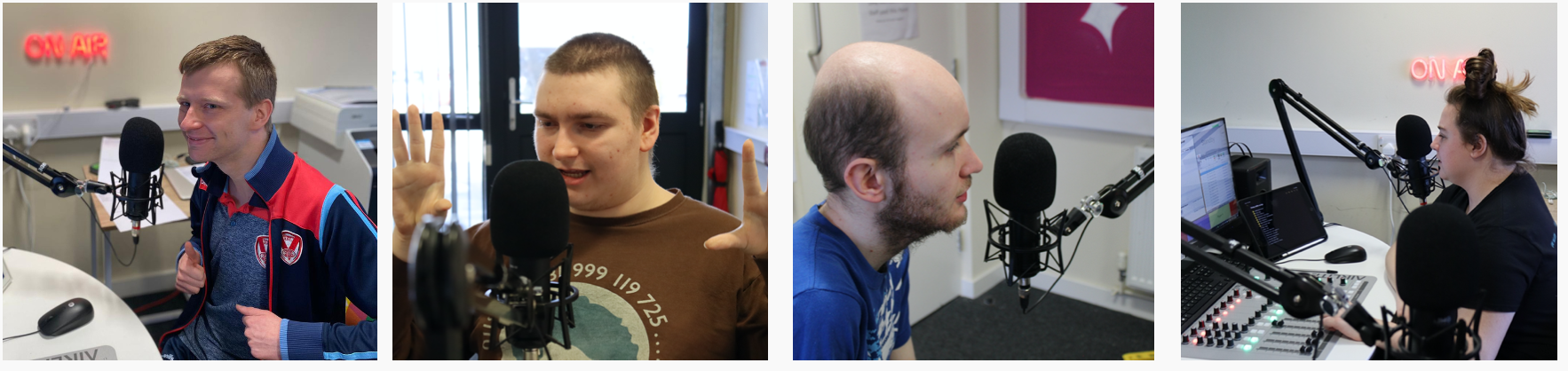
Our media groups have been enjoying getting to grips with planning and broadcasting their Radio Shows.
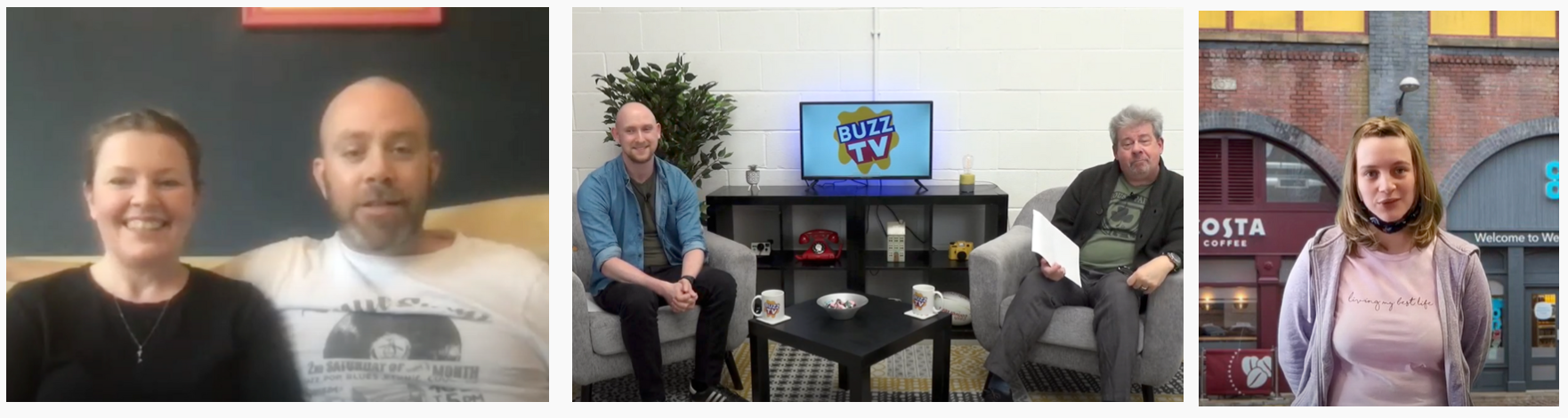
Buzz TV has recently launched with the interview of Verity and Iain Mc Cloud, writer and Producer of Coronation Street.
Buzz Grub
We have launched our accessible cook along videos, BUZZ GRUB. The videos will be accompanied with accessible recipe cards.
Zack’s Story is a short stop-motion animation that United Response created with the help of people we support to highlight the issues of climate change. In this third chapter of Zack’s story, Zack notices lots of plastic washed up on the beach and in the sea. He sees a documentary about climate change and gets very worried about the effects human behaviour is having on our planet. Keen to help before it’s too late, Zack and his friends think about what they can do to change things for the better.
The Karten photo printer was used to print some textures for the beach scene and one of the potential Karten students was involved in animating.
Discover more about the making of Zack’s Story in our Animation Diaries
Sense College Bedford thanks the Ian Karten Charitable Trust for their very kind and generous donation which is benefiting students of all different abilities through the use of technology.
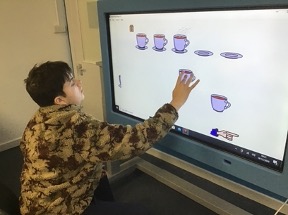
Charlie has been using the big screen to play interactive games that promote fine motor skills and the use of numeracy and literacy. Charlie loves the interactive part of these lessons, this interactive board is Charlie’s favourite piece of equipment as he is very much a cause and effect motivated learner.
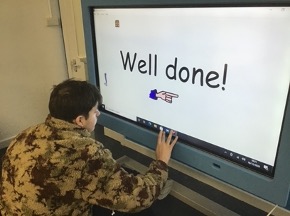
As per the pictures shown, Charlie can be seen pairing the cups to the saucers. This task corresponds nicely to his objectives and his ability to show a clear understanding of contextual numbers and counting.
In addition to this, this task also incorporates the use of literacy in the form of praise (as per the last image) where Charlie has completed the task and is being given praise in the form of “Well done!”.
This allows Charlie to understand clearly that he has finished the task correctly and can move on to the next one. The use of technology has been used to increase Charlie’s educational and psychological wellbeing as it combines something he enjoys in an educational setting to produce a desired outcome for his termly progress.
In December of last year, a new and truly life-changing innovative Wearable Assistive Technology device was launched for visually impaired people by a company called Envision who are based in the Netherlands. The company began by developing a fully accessible app for smart phones which is designed to assist with managing everyday tasks such as:
Reading printed and hand-written text (mail, newspapers etc
Describing what’s around you when you take a picture;
Colour recognition;
Barcode recognition;
Facial recognition;
Locating different objects such as chairs, tables, phone, etc.
The app is now used by many visually impaired people all over the world and is hugely popular. After a lot of positive feedback, Envision decided to integrate the app into a pair of smart glasses. This has now been achieved and I am delighted to say that the Envision Glasses are now available for purchase in the UK. The glasses have all of the app features as well as an explore mode which will tell you what’s around you in real-time and they also have a video-calling feature. This feature really does give these glasses an advantage over other wearable solutions as it allows you to connect with a sighted family member, friend or carer, who can then describe what they see through the camera of the glasses from the screen of their own smart phone. A constant and reliable internet connection is therefore required, but this can easily be achieved either by connecting the glasses through Wi-Fi or via the personal hotspot setting which is found on most up-to-date smart phones. You can also connect headphones or certain hearing-aids to work alongside the glasses either by using Bluetooth or through the USB-C charging port. So I think it’s fair to say at this point, that these glasses really do have everything covered! It’s also worth mentioning that all the information conveyed through the glasses is spoken or audio feedback, but if you are used to listening to a screen-reader on your computer or smart phone, then you shouldn’t have any issues with this. The glasses are operated using a touchpad which is found near the front of the right arm, so again, if you are used to using the VoiceOver or TalkBack Screen-readers on your smart phone or tablet, you will have no issues whatsoever in terms of learning how to use them.
My User Experience
I actually pre-ordered the Envision Glasses and have been using them since November. I can honestly say that they are one of the best purchases I have ever made and are worth every penny. I mainly use them for reading my own mail which is a great experience, as it means I don’t need to keep taking letters and post to my Mum and asking her what they are. I also used the glasses at Christmas to read a hand-written card sent by my neighbour. This is the first time I have been able to do this independently and I was really impressed in terms of how accurately the hand-writing was captured and read. I also use the glasses when out-and-about with my Guide Dog to describe my surroundings. On a recent walk, I went to my local park and took a picture of what was in front of me. I was told that there was a tree next to a bench. I was absolutely amazed by this, as I have walked around that park time-and-time again for the last fifteen years and had no idea that they were there. The video calling is my favourite feature though. I mainly use it when I’m stuck with a particular task such as organising tins in my cupboard or if my computer is not working and I need someone sighted to tell me what is on the screen. I now have all of my family members contact details stored, so if I’m ever struggling, I can just call one of them directly from the glasses and they can help me out. Think of the possibilities! I have always had difficulty knowing when to step-out to get on buses as I had no idea what number of bus was approaching. Not anymore! I’ll just call my Mum and she will be able to see the bus approaching through the camera of my glasses and keep me right. I also have serious problems finding an empty seat when I eventually manage to find the correct bus. Not anymore! Again, I can just call a family member and they can direct me to an empty seat. The possibilities are endless and to be honest, the only thing that will hold you back when using these glasses is your own imagination.
The really cool thing? This is only the beginning! Work is currently being done so that you will be able to control the glasses using your voice and there may even be the possibility of a navigation feature before too long, exciting stuff!
The Envision Glasses currently retail at £2695. Sight And Sound Technology are the UK distributor. However, we do work closely with Sight And Sound, so if you would like a demonstration or for more information, please contact Stuart Beveridge.
My name is Nicholas Cornwell, I am 21 years old and lockdown has had a drastic impact on the way I live my life. I have severe cerebral palsy with multiple complex health needs such as scoliosis, visual impairment, and a learning disability. My scoliosis has caused damage affecting my lungs and other internal organs, meaning that I have lessened lung capacity. All of these factors have made the covid experience extremely difficult and challenging for me and my family.
Life Pre-Covid
Before the pandemic, my friends would have described me as extremely extroverted and social. I ordinarily enjoy trips to the cinema, bowling, visits to the Apple store, as well as train journeys around the country. Missing out on social events such as these has taken a big toll on my day to day life.
Not being able to attend Hedley’s College (a specialised college for people with disabilities) has meant I have received limited access to my speech and language therapies, as well as my physio and hydrotherapy. I especially miss my hydrotherapy sessions, as this form of therapy is the only way I can achieve free movement and reduce spasms and discomfort.
The government guidance for the first lockdown was for me not to leave my house, and to limit all social contact. This change was staggering not only to me, but my family too. Being completely isolated from the outside world, I resorted to services such as Disney Plus and Audible, where I could watch all my favourite movies and listen to autobiographies from my favourite celebrities (I must give “The Meaning of Mariah Carey” a shout out here).
Getting Through It
Having to cancel my 21st birthday trip to Disney World Florida was a huge downer. I couldn’t even leave my house to go into the garden due to building work going on outside. My 21st birthday was not a disappointment, though. Drive-by visits from my friends, family and carers reminded me that there was light at the end of the tunnel. And although the first lockdown was definitely a challenge, it also had its lighter moments.
Daily FaceTime calls from my carers kept me entertained and were very uplifting, as well as zoom calls from College, St Oswald’s Hospice and quizzes with my friends. I was lucky enough to be loaned an Innowalk from Made for Movement. This is a specialist medical device that affords fully supported movement, a bit like a highly specialised cross-trainer.
A Word from Nicholas’s carer, Mary
During the first lockdown, I called Nick daily to keep him up to date with any drama going on in my life, as well as to laugh our way through random Facebook pages, such as Rate my Plate.
It is important to mention how much Nick really does love a bit of drama – I even added him to one of my group chats with some of my friends so we could keep him up to date with all the goings-on and just have a good chat! The main objective whilst Nick has been shielding has always been to keep him as happy and giggly as possible. If I can’t do that, I don’t think I’d be doing my job properly!
Getting Out and About
I mean what would life be like without any drama? Mary’s FaceTime calls did keep me totally up to date and well entertained! The second and third lockdowns have been somewhat easier than the first, as I’ve continued to access support from my care team (thanks to increased PPE supplied by Gateshead council and carer vaccinations) and even residential trips. We were so lucky in January, as I was able to go away to Brickhouse cottages in Blackpool for respite and finally use a hydrotherapy pool!
We can now go for drives and trips to places such as Starbucks, Dominos and Wagamamas (mainly to appease Mary’s obsession with the place when she is working) as well as lovely walks in quiet areas. This is completely different from what I was able to do in the first lockdown. However, there are still some challenges. The passing of Valentine’s Day and my anniversary has reminded me how much I miss my beautiful girlfriend Emily. Luckily, we did manage to have a FaceTime dinner date which made up for how much we missed each other on these special days.
One of my biggest concerns in the aftermath of the pandemic is losing access to places like the Bendrigg Trust. The Bendrigg Trust is a specialist outdoor activity centre providing residential opportunities for disabled people. I have been able to zip wire, abseil, canoe and do much more at Bendrigg, and these experiences have been life-changing. However the Bendrigg trust is currently struggling to survive with a lack of funding, and it would mean the world to me if this issue could be shared more widely.
Moving Forward
Although the past few lockdowns have had their ups and downs, the help of my family, friends and carers has helped me make it through! I can’t wait to go back to the cinema and see my friends again. I just hope everyone is keeping well and staying safe, don’t lose hope – the end is in sight!
Over the past 12 months, many people, including people with learning disabilities, have felt lonely and disconnected. Working in partnership with Learning Disability England (LDE) and their members, SeeAbility launched a six-month programme called Creating Connections. Funded the by the Department for Digital, Culture, Media and Sport via the National Lottery Community Fund, Creating Connections tackles isolation and loneliness among people with learning disabilities by helping people to connect with others online.
Veronica Mulenga, the Programme Lead, explains: “The project started during the pandemic when we were concerned about people with learning disabilities feeling isolated and lonely. SeeAbility’s all about helping people to be involved in their communities, and we could see the pandemic being a real barrier to that.
“Even before the pandemic, more and more aspects of life were moving online. The last year has just seen a real acceleration of that process, and more and more people, especially with learning disabilities, are finding that process difficult. It affects every aspect of inclusion, from education to employment to just staying in touch with friends and family. There are huge parts of life that have become inaccessible if you can’t get online. We had to step in and do something, and that’s what Creating Connections is all about.”
At the heart of the programme is collaboration. SeeAbility is acting as a facilitator, bringing together lots of organisations and self-advocacy groups from across the country. It’s a project that is ultimately led by people with lived experience, designing a programme that works for them.
“It’s a real partnerships project” says Veronica. “We’ve linked up with LDE and there are 23 self-advocacy groups from across the country who have been delivering the activities of the project. They’ve been instrumental in making all this work and building connections within their communities. “The other aspect of the project is our role in recruiting volunteers to support people to learn digital skills. This is exciting as it’s a whole new approach to volunteering. Traditionally volunteering has always been face-to-face, but we’re pushing the boundaries of how people are able to volunteer and get involved online. Many of these volunteers have learning disabilities themselves.”
Together with our partners we have reached 1473 people and delivered nearly 400 online sessions. Crucially, this work is helping people to develop skills, build meaningful relationships and support their peers.
Thanks to support through Creating Connections, people like Jess are going on to act as a peer supporters and create change for other people with learning disabilities.
Training to get online and access video calling has opened up a world of opportunities for Jess. Since learning how to download Zoom and join calls, Jess has attended social and activity groups that have helped her stay connected and meet friends.
Jess, 35, is passionate about sign language and has been supported to facilitate a virtual British Sign Language (BSL) group. In the future, Jess wants to gain a qualification as a trainer of BSL and become an interpreter. Jess says: “I want use sign language as a way of helping other people. I have lots of deaf friends and they wanted me to teach them. Now I want to help more people to communicate how they feel through sign language.”
In a digital society, access to technology enables people to connect with their communities. We’re working to extend the Creating Connections programme to end isolation and digital exclusion for people with learning disabilities, autism and sight loss. We know that communities are stronger when people pull together and connect to support each other.
We are pleased to introduce Oscar. He is a student at Treloar College and has cerebral palsy and communication challenges. He spends his days learning within an Ian Karten Centre (IKC) at Treloar College, set up in September 2001 to provide a real working environment in which to offer a range of qualifications. Known externally as ‘TreloarPrint’ for marketing purposes, this successful and popular enterprise provides a high quality printing and finishing service at competitive rates for a wide range of customers.
Oscar is studying for his City & Guilds NVQ Level 1 in Business and Administration within the IKC/TreloarPrint and can get involved with things like assisting customers, preparing quotes and seeing a print job through to completion and delivery. These work experience opportunities are helping to prepare him for life beyond Treloar’s and at the same time building his confidence and self-esteem.
Oscar has some fabulous and wide ranging interests including mythology, ancient weaponry, true crime stories, his charity work, cooking and poetry. We are delighted to share with you here his wonderful and extremely powerful poem.
“See through the wheelchair” For some reason people used to glare at me. But I don’t know why, maybe it’s because of my wonky body or the fact that I am stuck in a wheelchair. The problem is that no one asks me. Mainly due to fear. The fear of being rude and offensive, but I just wanna be talked to. Disabled people also have lives and voices you know, they laugh, cry and feel pain just like you do. But the most important thing they do. Is that they live their lives to the fullest. So I implore you to please see through the wheelchair. And take care of the boy inside.
Oscar even had the honour of his poem being read at The Company of Communicators Poetry reading evening in December 2020. There were almost 40 members from the Company who attended, including the Lady Mayoress of the City of London, Mrs Hilary Russell who said Oscar’s poem was beautiful and very moving.
All at Treloar’s are extremely proud of Oscar and are very grateful to the Karten Network for their generosity in providing opportunities for our students to learn and grow in confidence in this way.
In 2018 FitzRoy was lucky enough to be awarded Ian Karten Charitable Trust funding to buy 8 iPads and a Clevertouch screen to be used at our On Track day service for those with learning disabilities in Petersfield, Hampshire.
Each day, before the COVID-19 pandemic, these items were being used to support our members via a daily menu of activities, from playing games on iPads, through to watching sensory projections on the Clevertouch screen.
This equipment was already well used and well loved but by the time the COVID-19 pandemic struck little did we know how vital a role these items of assistive technology would play during the past year.
When On Track was lawfully required to close its doors in March 2020, our support workers set about doing all they practically could to help those who needed it. Their outreach programme included phone calls and as many doorstop ‘hellos’ as possible, but while the virus raged, most of our On Track staff were re-deployed to support the challenge of keeping our registered care homes for those with learning disabilities fully staffed.
However, as summer came, and our On Track staff resumed their usual roles, they began to think about how they could use the iPads and Clevertouch screen technology to bring the usual schedule of daily activities into the homes of those they support.
They were acutely aware that the absence of daily contact had taken its toll on our members’ mental health, who were telling us that they were feeling isolated, lonely, and depressed because everything they enjoyed had been taken away from them. Our On Track team were also concerned about the impact the sudden loss of support was having on the households and carers of those we help. These people were finding it particularly tough; they knew they had to stay at home and keep their loved ones safe, but they too were feeling alone, bereft, and exhausted, having dedicated all their time since March to caring, with little or no time for respite.
Disco afternoons
With in-person activities impossible, the team decided to embrace technology and find a virtual way to be with people in their own homes instead. As part of this they loaned Karten funded iPads to individuals who did not have access to a digital device and began using the Clevertouch screen to deliver online classes. These classes take place Monday to Friday, are 30 minutes long and happen six times a day. On Track has been running these virtual sessions since September and the response has been fantastic!
Staff dressed for themed Fridays – Toy Story day
Each day our staff use the Clevertouch screen to beam themselves into the homes of around 30 people who have chosen to take part in an array of activities. The daily schedule of activities includes arts and crafts, Makaton, Zumba classes, Disco afternoons, and themed Fridays such as Toy Story day and Grease the Musical Day. The team have also been using a Karten funded iPad alongside the Clevertouch screen to create a breakout group for those who need extra help, and to get close-up images of any of the activities which they might be doing.
Pancakes ready for delivery
The most popular event so far has been the hugely enjoyable Pancake Day Zoom! In the run up to the occasion, our dedicated staff took each On Track member two pancakes and toppings such as chocolate spread, jam, sugar, and sprinkles, before everyone came together over Zoom for a pancake decorating competition and lots of enthusiastic pancake tossing!
The Karten funded technology has transformed the way On Track has been able to operate during the pandemic. Danielle Styles, On Track’s Activities Coordinator has said how ‘incredible’ the Clevertouch screen has been, saying ‘we wouldn’t have been able to deliver activities as well without it. Using a TV screen or laptop screen just wouldn’t have had the same effect’. This technology has also had many other benefits on our On Track community. Because of it our members have continued to engage with the service despite not attending in person. Friendships have been maintained with other service users and staff, members have been more active, and feelings of isolation and loneliness have reduced.
The mother of one of our members has been extremely thankful emailing to say the ‘Zoom sessions have been a really great resource, especially as they offer such a wide range of supported activities each week-day. The difference they have made to Mark’s life has been enormous.’ She like many of those we have spoken to have highlighted how essential these Zoom sessions have been to not only improving mental health and well-being during this time, but also for the respite it allows the carers of those we support.
Everyone in our On Track community is so grateful for the funding we have received from the Ian Karten Charitable Trust. Although our members are very keen to see each other in person and not on a screen, the Clevertouch screen and iPads have been, and will continue to be, an essential lifeline into the months and years ahead.
We use cookies on our website to give you the most relevant experience by remembering your preferences and repeat visits. By clicking “Accept All”, you consent to the use of ALL the cookies. However, you may visit "Cookie Settings" to provide a controlled consent.
This website uses cookies to improve your experience while you navigate through the website. Out of these, the cookies that are categorized as necessary are stored on your browser as they are essential for the working of basic functionalities of the website. We also use third-party cookies that help us analyze and understand how you use this website. These cookies will be stored in your browser only with your consent. You also have the option to opt-out of these cookies. But opting out of some of these cookies may affect your browsing experience.
Necessary cookies are absolutely essential for the website to function properly. These cookies ensure basic functionalities and security features of the website, anonymously.
Cookie
Duration
Description
cookielawinfo-checkbox-analytics
11 months
This cookie is set by GDPR Cookie Consent plugin. The cookie is used to store the user consent for the cookies in the category "Analytics".
cookielawinfo-checkbox-functional
11 months
The cookie is set by GDPR cookie consent to record the user consent for the cookies in the category "Functional".
cookielawinfo-checkbox-necessary
11 months
This cookie is set by GDPR Cookie Consent plugin. The cookies is used to store the user consent for the cookies in the category "Necessary".
cookielawinfo-checkbox-others
11 months
This cookie is set by GDPR Cookie Consent plugin. The cookie is used to store the user consent for the cookies in the category "Other.
cookielawinfo-checkbox-performance
11 months
This cookie is set by GDPR Cookie Consent plugin. The cookie is used to store the user consent for the cookies in the category "Performance".
viewed_cookie_policy
11 months
The cookie is set by the GDPR Cookie Consent plugin and is used to store whether or not user has consented to the use of cookies. It does not store any personal data.
Functional cookies help to perform certain functionalities like sharing the content of the website on social media platforms, collect feedbacks, and other third-party features.
Performance cookies are used to understand and analyze the key performance indexes of the website which helps in delivering a better user experience for the visitors.
Analytical cookies are used to understand how visitors interact with the website. These cookies help provide information on metrics the number of visitors, bounce rate, traffic source, etc.
Advertisement cookies are used to provide visitors with relevant ads and marketing campaigns. These cookies track visitors across websites and collect information to provide customized ads.